Abstract:

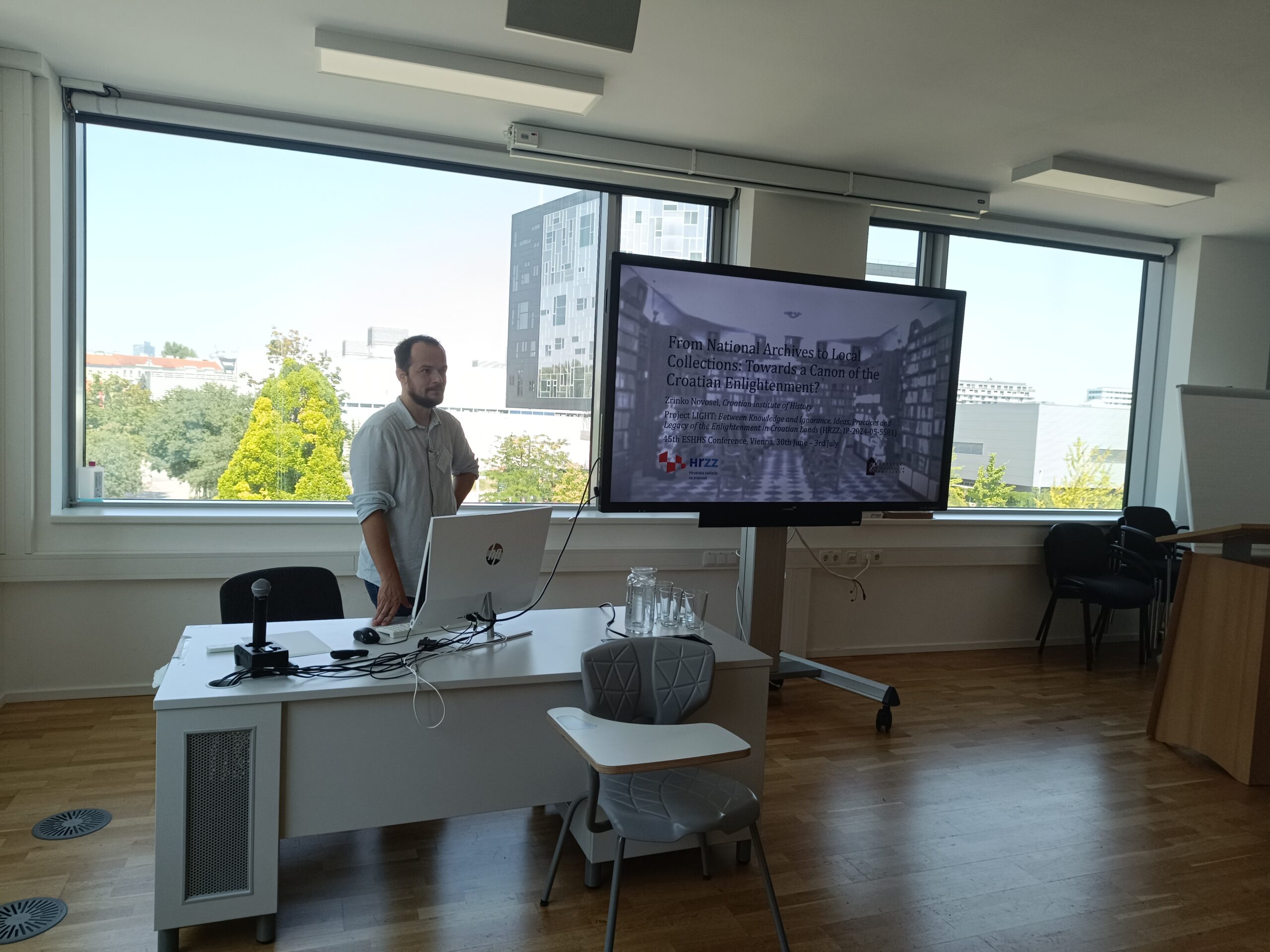
Recent historical investigations of the Croatian Enlightenment aim at dealing with source material, and evaluation of the state of affairs in historiography. Even though there are many published sources and case studies that speak to the topic of cultural, intellectual and political history of the ‘long’ 18th century in Croatia, they predominantly focus on ‘prominent’ individuals or key institutions. Alleviating the discrepancy between particular historiographic interests and available archival sources through extensive research has so far yielded some results. It has also made it clear that tackling the traditional idea of archives as institutions of objective authority is of essence. While often perceived as neutral repositories of the past, the archives are also places of their own organizational methodology, capacity and spatial logic.
These observations and their repercussions for the nature of archival research on the topic of the Croatian Enlightenment have accompanied recent attempts to collect and contextualize source records relating to various aspects of intellectual and cultural life. This paper aims to present the experience and results stemming from mapping of legal knowledge, which, newly reformed in the mid-18th century, was one of the cornerstones of intellectual exchange in academic circles in the late enlightenment. Natural, public, and the law of the nations were given primary significance in the higher educational curricula throughout the Monarchy. This legal material was also taught by professional jurists at the only higher educational institution in Croatian lands during the late enlightenment period, the Royal Academy of Sciences in Zagreb. The legal teachings at the reformed University of Vienna, but also the central political body for education in Buda (from 1784 Pest), defined the educational policy and content of legal knowledge which was taught by the professors at the Academy. Therefore, the archival research of legal texts which were produced and used in Zagreb, must overcome contemporary national boundaries, language barriers, and the specific organizational logic of national and university archives.
However, in an attempt to envision a canon of legal texts, the practice of collecting the source material by recognizing the spatial and archival distribution of known and accessible legal works is not the only condition that has to be considered. Apart from administrative records on legal education and institutionally recognized body of legal literature, Enlightenment professors harboured their own interests in teaching and producing new knowledge. The investigation of individual professors’ records and private libraries can in this sense prove indicative. Professor Vinko Kalafatić (1747-1792) held the chair of natural, public and the law of nations in Zagreb and his works are preserved in archival repositories in various known locations. However, disagreeing with the josephinist reforms of education and religious life, he abandoned the position and became a local parish priest in the village of Pokupsko. Only recently discovered in the parish archives, which are not organized according to archival conventions, Kalafatić’s collection of books speaks to his intellectual interests in legal material, particularly canon law. Their content also contradicts the imagined body of ‘mainstream’ legal literature. Therefore, bibliometrical or content analysis of Enlightenment legal texts has to take into consideration various archival repositories of a profoundly local character. Investigation of Kalafatić’s personal book collection in Pokupsko highlights the issues of archival spatial and organizational conditioning. Bearing these in mind, an attempt to evaluate the significance of local material against archival records in the central institutions of Vienna, Budapest and Zagreb, can serve as a stepping stone for a more comprehensive approach to evaluating the canon of the enlightenment legal texts in Croatia.
 We find it appropriate […] to promote the establishment of a Trading Company, which, by uniting its strength, knowledge, and care, will strive […] to develop the various branches of a necessary and profitable commerce.