


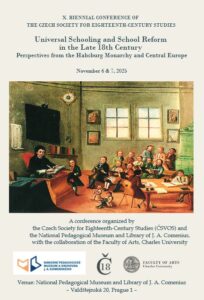
 Dr. Teodora Shek Brnardić, principal investigator, participated in the 10th Biennial of the Czech Society for Eighteenth-Century Studies. The conference, organized in connection with the 250th anniversary of the first edition of Abbot Ignaz von Felbiger’s Methodenbuch (1775), was titled Universal Schooling and School Reform in the Late 18th Century: Perspectives from the Habsburg Monarchy and Central Europe. It took place from November 6 to 7, 2025, at the National Pedagogical Museum and Library of J. A. Comenius in Prague, co-organized with the Faculty of Arts at Charles University.
The programm booklet is available here.
Dr. Shek Brnardić delivered a presentation entitled Reimagining Noble Upbringing: Franz Joseph Kinsky’s Enlightenment Educational Reforms on the first day of the biennial, within the thematic session on pedagogical theories and ideas. Austrian general and Czech nobleman Franz Joseph Kinsky (1739–1805) is a notable figure in the Czech national revival for advocating the teaching of the Czech language.
In her presentation, Dr. Shek Brnardić explored the context and content of Kinsky’s works on noble education, which he implemented during his tenure as director of the military academy in Wiener Neustadt. She shared findings from recent archival research and project work on his manuscript travelogue through the Croatian lands and Banat in 1788.
Around twenty researchers from the Czech Republic, Austria, Ukraine, Serbia, Hungary, and Poland participated in the conference.
Abstract:

In the eighteenth century, the anthropologisation of the world view—rooted in investigations of human nature—proliferated across Europe. This trend also reached the Bohemian Crown lands, which contemporaries seldom associated with Enlightenment because of serfdom and the Catholic Counter-Reformation milieu. Yet local figures, such as the Austrian General and Bohemian Count Franz Joseph Kinsky (1739–1805), leveraged privately acquired knowledge of human nature (Germ. Menschenkenntnis) to exhort noble compatriots to refine their manners and to reform their educational practices. These efforts culminated in Kinsky’s educational treatises Erinnerung über einem wichtigen Gegenstand von einem Böhmen (1773) and Über die Hofmeister (1776), directed at noble audiences. In these works, Kinsky outlined programs for cultivating a young nobleman and offered guidance to parents on the attributes and competencies a good tutor should possess. The central aim of this paper is to examine the “human language” embedded in Kinsky’s texts, both in the domain of noble education and in military pedagogy. I argue that a Christian conception of humanity was not antithetical to the Enlightenment anthropological project. In addition, I will be presenting new archival sources that supplement Kinsky’s biography. This includes an engagement with his manuscript travelogue through Croatia, Slavonia, and Banat (1788), as part of the Croatian Science Foundation project “Between Knowledge and Ignorance: Ideas, Practices and Legacy of the Enlightenment in Croatian Lands” (IP-2024-05-5581).
 We find it appropriate […] to promote the establishment of a Trading Company, which, by uniting its strength, knowledge, and care, will strive […] to develop the various branches of a necessary and profitable commerce.


